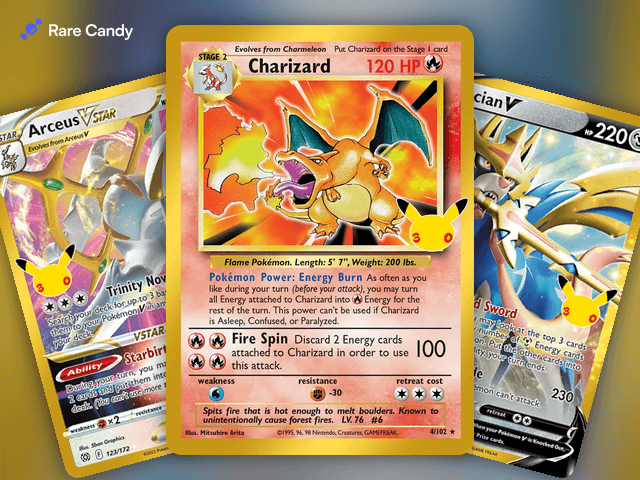
All 30th Celebration Classic Collection Reprints
Only one other Pokémon set has ever tried to summarize the entire trading card game inside one 30 card checklist before (25th Anniversary Celebrations did it with 25 cards). That's what 30th Celebration's Classic Collection does, one gold bordered reprint for every era of the game, running all the way from a 1999 Base Set Charizard to a 2023 Paldea Evolved Magikarp. Each card carries the set's own thirty stamp, but every single one of these cards was already historically important long before this anniversary gave it a second printing.
This post walks through all 30, in the order they were originally printed, with the story behind the set each one came from. For the other half of 30th Celebration's chase mechanic, see our breakdown of all 30 Pikachu cards in the set's illustration subset.
Scan and track your Pokémon cards and rip digital packs backed by REAL cards with the Rare Candy App!

1. Pikachu (58/102), Base Set
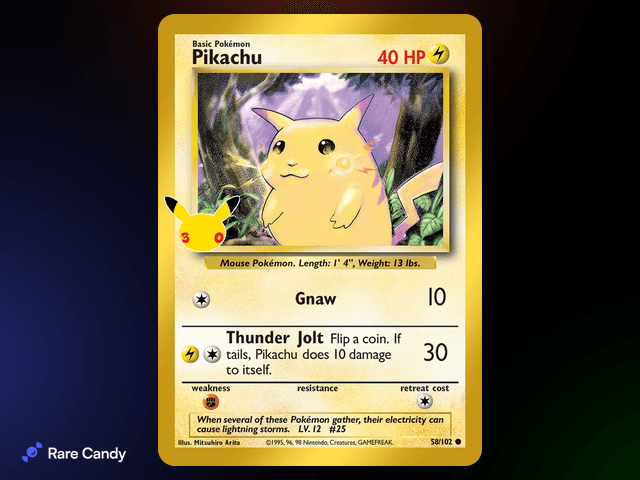
Base Set is where the entire English print run of the Pokémon TCG begins, released by Wizards of the Coast on January 9, 1999, and this common little Pikachu was many collectors' literal first pull. It's not a rare, not a holo, nothing about the card demanded a reprint on paper. What earns it a spot here is that it's illustrated by Mitsuhiro Arita, the same artist who'd go on to paint the single most famous Pokémon card ever made which you'll see next up on this list, and his name turns up on this list more than almost anyone else once you get through all 30.
2. Charizard (4/102), Base Set
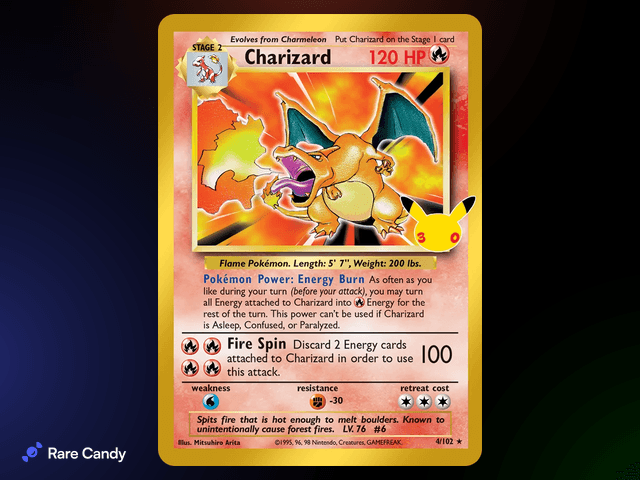
If one card built the entire modern grading and collecting industry around Pokémon, it's this one. Base Set Charizard, holofoil, numbered 4 of 102, illustrated by Mitsuhiro Arita, has spent three decades as the single most recognized Pokémon card in the world, the kind of card that turns up in celebrity unboxings and PSA 10 sales that make actual news. Nothing else in this Classic Collection carries this card's name recognition outside the hobby, and putting it right after Arita's own Pikachu makes the pattern obvious immediately, the same artist opening this entire list twice in a row.
3. Misty (18/132), Gym Heroes
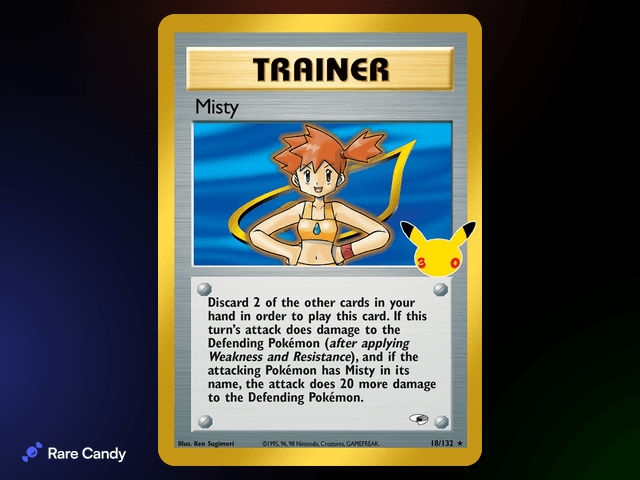
Gym Heroes was the first set to treat Kanto's Gym Leaders as characters instead of just flavor text, giving each one in the set a Trainer card built around their own specialty. Misty's card, illustrated by Ken Sugimori, plays exactly like you'd expect a Water type Gym Leader to, built to smooth out a Water heavy deck rather than swing for damage on its own. It's a quieter pull than most of what's on this list, but it's the moment the TCG started building deck identities around specific characters instead of just Pokémon types.
4. Erika's Jigglypuff (69/132), Gym Challenge
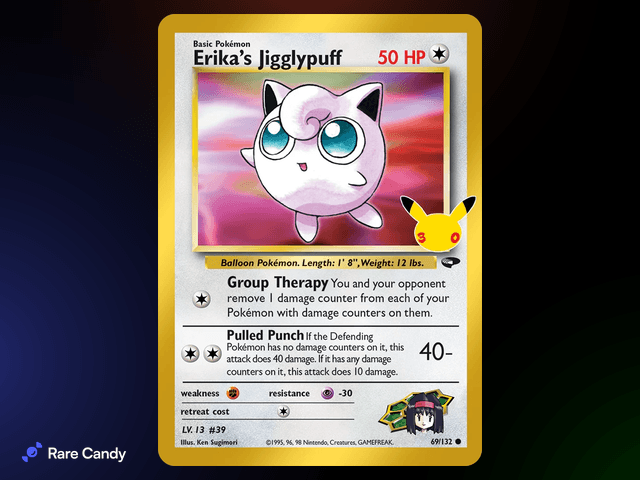
Gym Challenge followed Gym Heroes just two months later in 2000, finishing the job of giving every Kanto Gym Leader their own themed cards, right down to Pokémon that carry the Leader's name directly in the card title. Erika's Jigglypuff, illustrated by Ken Sugimori for the second entry in a row on this list, is one of those Leader-and-Pokémon pairings unique to the two Gym sets, tying a Grass type specialist's signature Pokémon to her deck archetype. It's a small, easy to overlook piece of TCG history, since no other era of the game had repeated that exact naming convention until Journey Together in the Scarlet & Violet era.
5. Sneasel (25/111), Neo Genesis
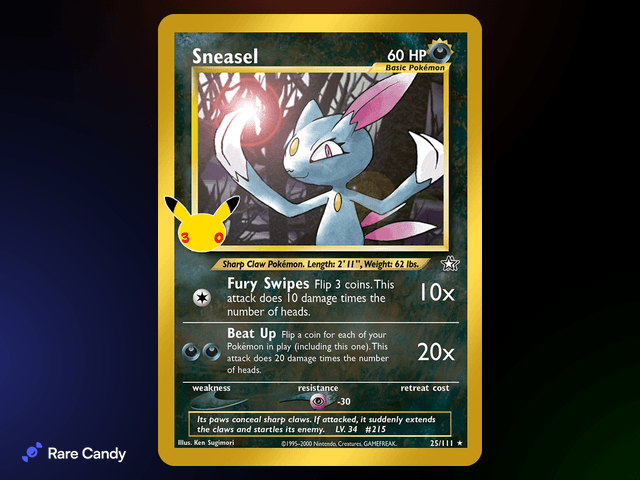
Neo Genesis is where the Pokémon TCG stopped being just a Kanto game. Released in December 2000, it was the first set built entirely around Generation II, introducing Johto Pokémon, Baby Pokémon, and an entirely new Dark type to match what Gold and Silver had just added to the games. Sneasel, illustrated by Ken Sugimori for the third straight entry on this list, was part of that very first Dark type wave, a mechanic that gave Team Rocket's whole aesthetic a real gameplay identity for the first time. Everything from Lugia's chase status to this Sneasel's spot on shelves traces back to the exact set that proved the TCG could grow past its first 151.
6. Shining Celebi (106/105), Neo Destiny
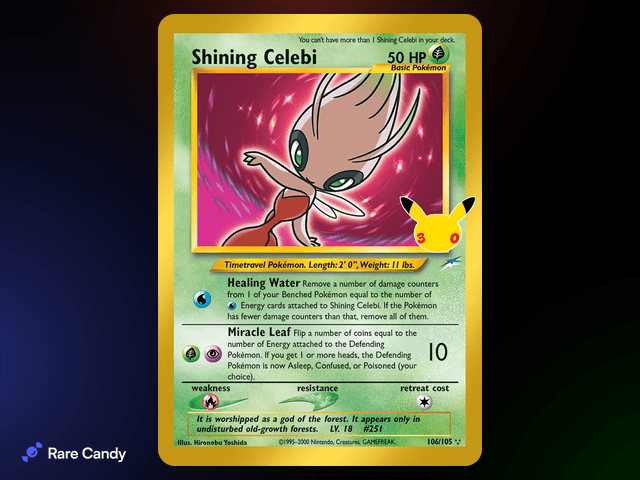
Neo Destiny closed out the Neo era in February 2002, and it's remembered today for one specific idea: Shining Pokémon, secret cards numbered above the set's own total, two decades before "secret rare" became a phrase every collector uses casually. Shining Celebi, illustrated by Hironobu Yoshida, was part of that original wave, and putting a time travelling mythical on the card that helped cement the entire secret rare concept feels appropriate. This is the actual ancestor of every alt art secret rare pull chased today, whether it's a Shining Charizard from two decades ago or a Special Illustration Rare pulled last month.
7. Crystal Lugia (149/147), Aquapolis
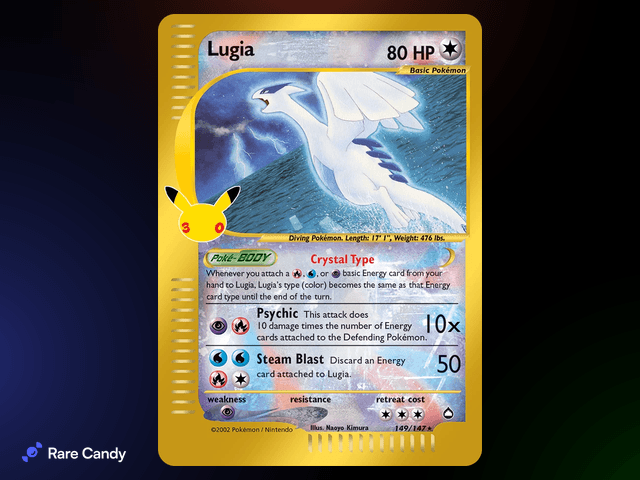
Aquapolis arrived in 2003 as part of the short lived e-Card series, the only era of the TCG built around a dot code strip that could be scanned into a Game Boy device called the e-Reader. That gimmick didn't last, but Aquapolis left behind "Crystal" Pokémon, an early rare tier built around alternate, glassier artwork of an already existing Pokémon. Crystal Lugia, illustrated by Naoyo Kimura, sat at the very top of that chase. Kimura is the same illustrator behind the Pokémon x Van Gogh Museum Pikachu covered in our other 30th Celebration Pikachu post, and she'd already been painting for the TCG since 2001.
8. Delcatty (5/109), EX Ruby & Sapphire
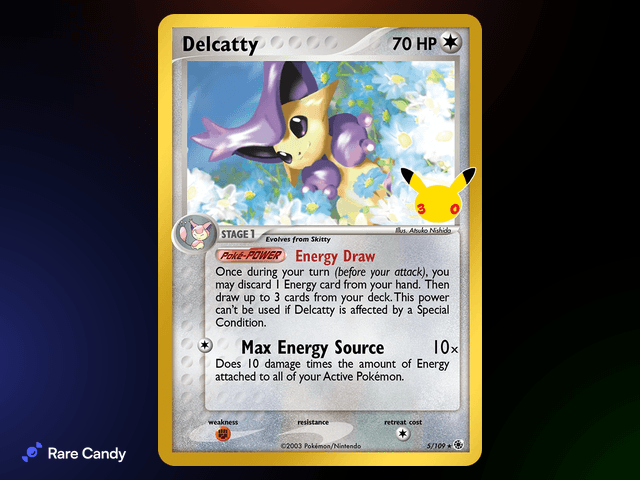
EX Ruby & Sapphire kicked off the entire EX Series in 2003, and its real legacy is the Pokémon-ex mechanic itself, oversized HP, a bigger attack, and two Prize cards given up on knockout in exchange. That single design decision is the direct ancestor of every V, VSTAR, and modern ex card printed today. Delcatty isn't an ex itself, it's a standard rare from the same set, but the illustrator credit is the real reason it belongs here: Atsuko Nishida, the Game Freak designer behind Pikachu's original character design.
9. Dark Tyranitar (19/109), EX Team Rocket Returns
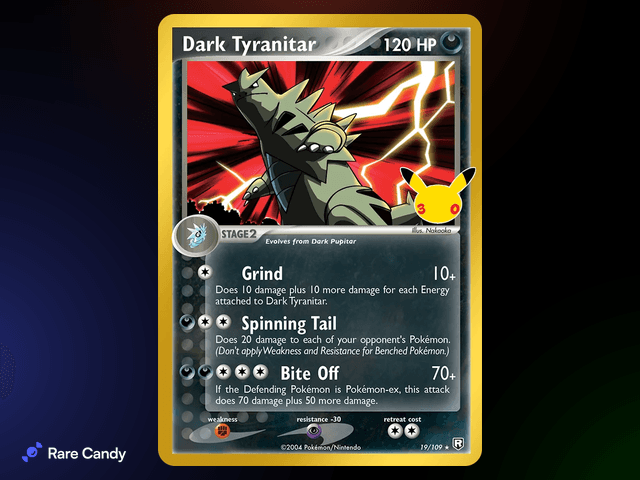
Before Dark Tyranitar, there was just Team Rocket, the original WOTC set that turned Pokémon villains into a playable archetype with a discounted energy cost and a damage bonus built right into the card. EX Team Rocket Returns brought that idea back in 2004, and Dark Tyranitar, illustrated by Nakaoka, is one of the clearer examples of why it worked the second time around too. A Pokémon that's already intimidating in the games gets an extra layer of menace once the Dark mechanic stacks on top of it.
10. Scizor ex (108/115), EX Unseen Forces
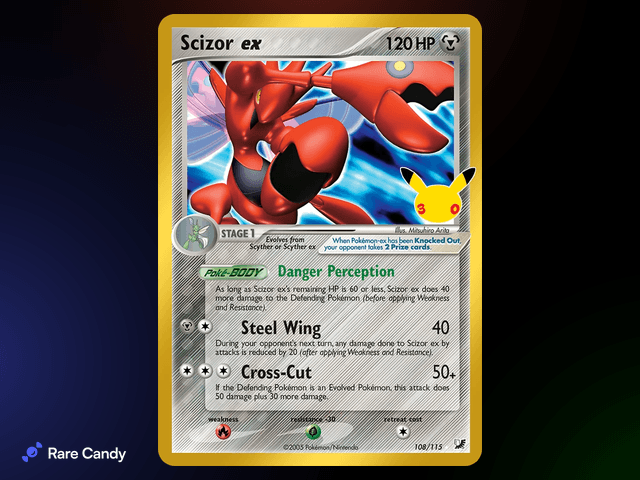
EX Unseen Forces like many EX era sets blended two very different ideas in the same set, Pokémon-ex cards for Johto's roster, and the debut of Gold Star Pokémon, secret rares that would go on to become some of the most expensive cards from the entire EX era. Scizor ex, illustrated by Mitsuhiro Arita for the third time on this list after Pikachu and Charizard both from Base Set, isn't one of the Stars, but it's a sharp example of what the ex mechanic looked like once the format had a couple years to refine it, a Bug and Steel type built for straightforward, high damage attacking rather than a gimmick.
11. Metagross (11/113), EX Delta Species
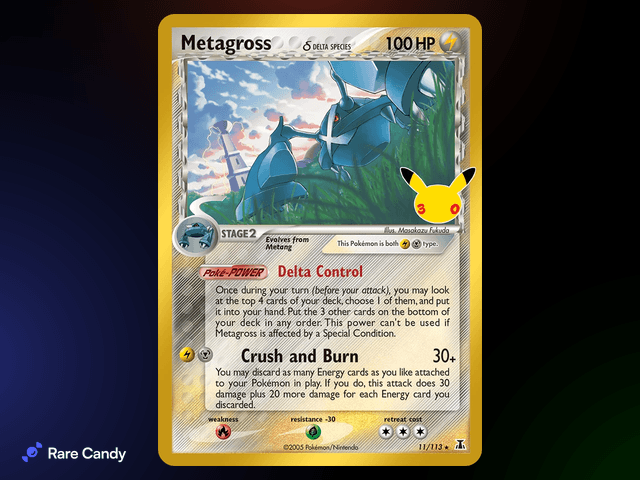
EX Delta Species, from 2005, is one of the strangest experiments the TCG ever ran, Pokémon printed completely off their expected type, marked with a small delta symbol to flag the swap. This Metagross, illustrated by Masakazu Fukuda, is Lightning type here despite being Steel and Psychic in the games, and that single detail is the entire reason this card is still a talking point almost twenty years later. Delta Species never became a recurring mechanic, which makes every card from this set feel like a one off snapshot of an idea Pokémon tried once and moved on from, unless of course you include Terastal cards introduced in the Scarlet & Violet era.
12. Palkia LV.X (106/106), Great Encounters
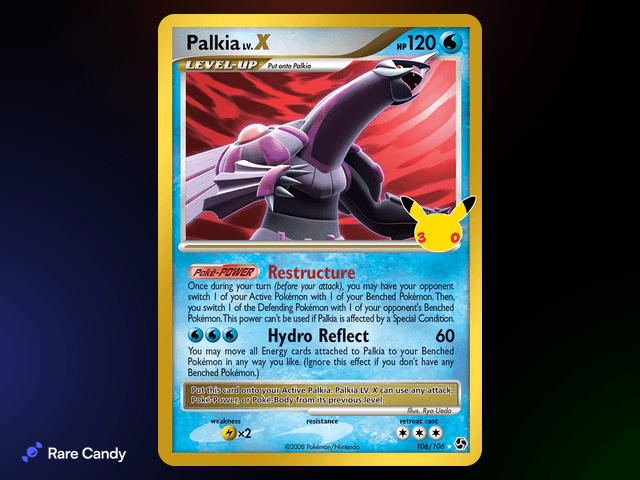
The LV.X mechanic showed up in 2008's Great Encounters, part of the Diamond & Pearl series, a special evolution played directly on top of an existing Pokémon already in play rather than replacing it outright. It's the same basic idea VSTAR would repeat over a decade later, just with a different name and a different border. Palkia LV.X sits at card 106 of 106, the literal last print in the set, illustrated by Ryo Ueda, and closing out a Diamond & Pearl era set with the mechanic's own signature legendary is exactly the kind of placement that doesn't happen by accident.
13. Uxie LV.55 (43/146), Legends Awakened
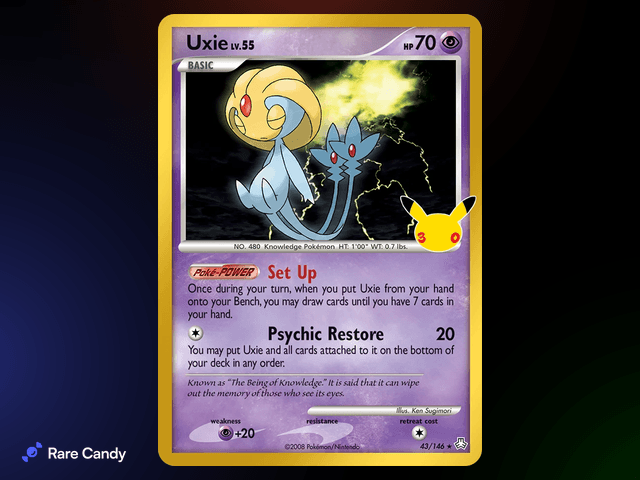
Legends Awakened, also 2008, is where the Sinnoh Lake Trio, Uxie, Mesprit, and Azelf, got their full TCG introduction alongside Giratina, well before Pokémon Platinum ever gave that trio a starring role in the games. Uxie's card here is illustrated by Ken Sugimori, already responsible for three cards earlier on this list (Misty, Erika's Jigglypuff, and Sneasel) and the same artist who opens the 30th Celebration Pikachu subset with a recreation of the character's original Jungle appearance.
14. Crobat G (47/127), Platinum
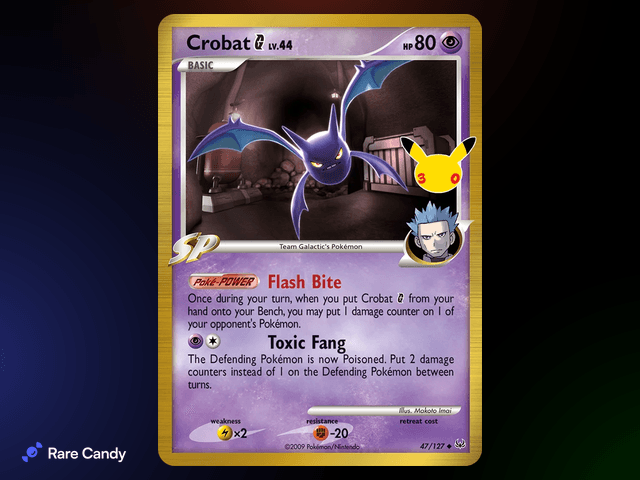
Platinum, released in 2009, is the set that finally gave players a Team Galactic villain arc to match the Diamond & Pearl games, introducing "Pokémon G" cards tied directly to Galactic's Commanders and Boss. Crobat G, illustrated by Makoto Imai, wears that Galactic branding right on the card, and it's one of the clearer examples of the TCG building an entire villain mechanic around a specific in game organization rather than just printing strong Pokémon and calling it a themed set.
15. Gengar Prime (94/102), HGSS Triumphant
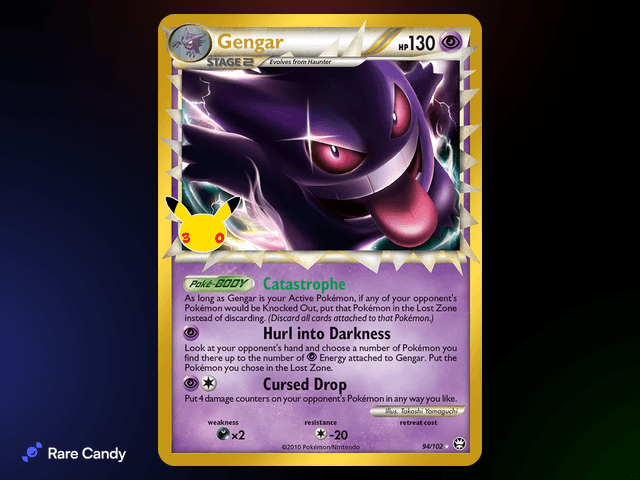
HeartGold & SoulSilver: Triumphant closed out the HGSS (Unless you count Call of Legends) series in 2010 with a wave of "Prime" cards, souped up reprints of classic Pokémon carrying a Poké-BODY instead of the era's usual Ability template. Gengar Prime, illustrated by Takashi Yamaguchi, is one of the most played of the bunch, an Ability that sends opposing knockouts to the Lost Zone instead of the discard pile, which was genuinely disruptive in the format at the time. Triumphant leaned hard into nostalgia for Gen II's remakes, and Prime cards were the mechanic that made it stick.
16. Darkrai & Cresselia LEGEND (99/102 & 100/102), HGSS Triumphant
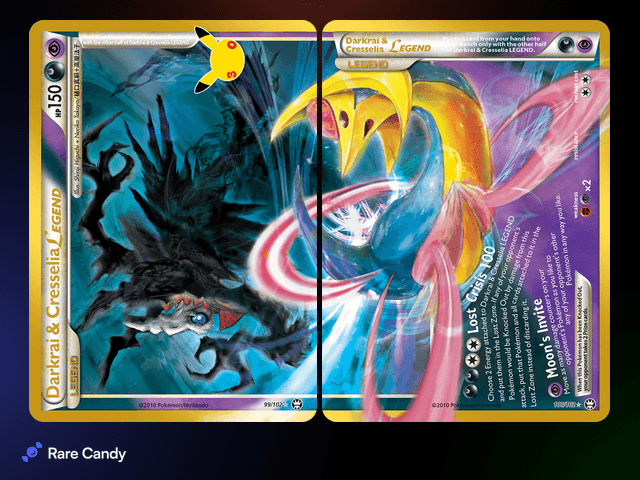
LEGEND cards only existed for one stretch of the TCG, two half artworks that had to be placed side by side on the Bench to form one complete illustration and one playable card, a mechanic the HGSS series introduced and then retired once Triumphant wrapped it up. Darkrai & Cresselia LEGEND, illustrated by Shinji Higuchi and Noriko Takaya, is one of the format's most requested pairs to pull complete, both halves showing up in the same booster box being genuinely rare. It's also one of the clearest examples of connected artwork in the entire hobby, since owning only half the card is functionally owning nothing at all.
17. N (101/101), Noble Victories

N stopped being just a Black & White story character in 2011's Noble Victories and became one of the most influential Supporter cards ever printed: shuffle both hands into the deck, then draw based on Prize cards remaining. Every comeback style Supporter since, Colress, Cynthia, N himself getting reprinted repeatedly, owes something to this exact card. It's illustrated by Ken Sugimori, his fifth and final appearance on this list, and closing out card 101 of 101 with the set's own defining Supporter is the same kind of intentional placement Great Encounters used for Palkia LV.X back at card 106 of 106.
18. Rayquaza EX (85/124), Dragons Exalted
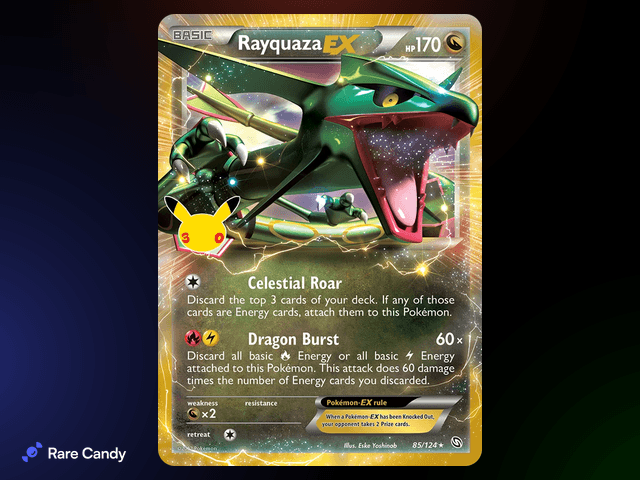
Dragons Exalted, 2012, is the only Black & White set built entirely around Dragon type (Beside the very small special set, Dragon Vault), a category the video games had only just given Pokémon that same generation. Rayquaza EX, illustrated by Eske Yoshinob, was the obvious choice to lead that charge, a Pokémon whose entire design already reads as a dragon even before the TCG had a type box to put it in. It's one of the most collected EX cards from the era specifically because the set built around it never got a real sequel.
19. Genesect EX (11/101), Plasma Blast
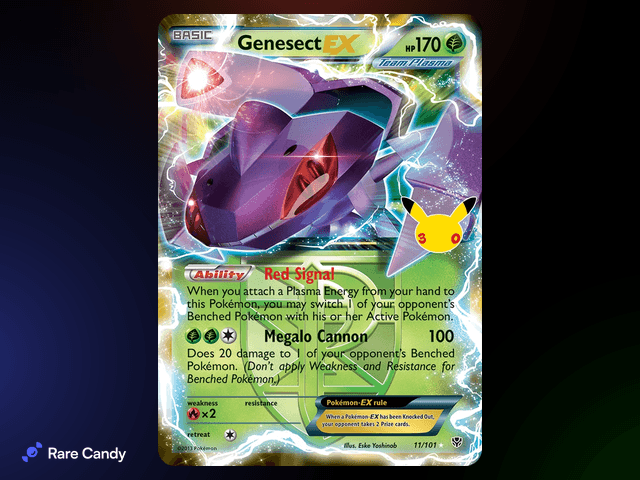
By the time Plasma Blast came along in 2013, Team Plasma's endgame plot had taken over the cards too, right down to a genetically modified, armor plated Genesect built around the group's own storyline. Genesect EX carries the Team Plasma branding right in its subtype, illustrated once again by Eske Yoshinob.
20. M Gardevoir EX (106/160), Primal Clash
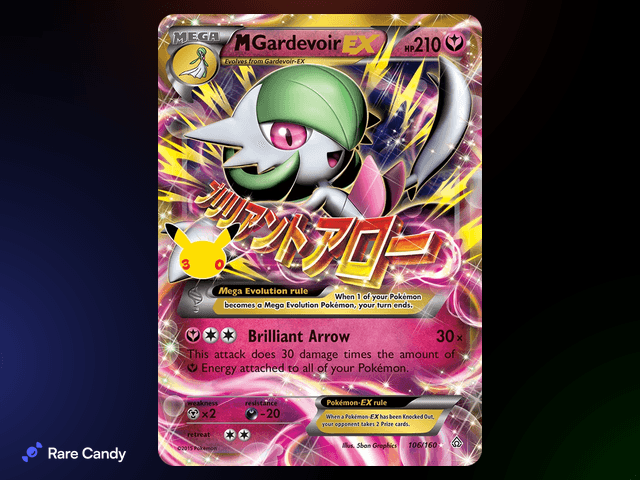
Two big ideas from Omega Ruby & Alpha Sapphire landed in the same set with 2015's Primal Clash, Mega Evolution as a playable mechanic, and Primal Groudon and Kyogre as their own separate rarity tier. M Gardevoir EX represents the Mega half of that split, one of the format's most explosive attackers when built around enough Fairy Energy. Primal Clash is the exact moment the TCG figured out how to translate a video game mechanic that changes a Pokémon's form mid battle into something that actually works on a card.
21. Greninja BREAK (41/122), BREAKpoint
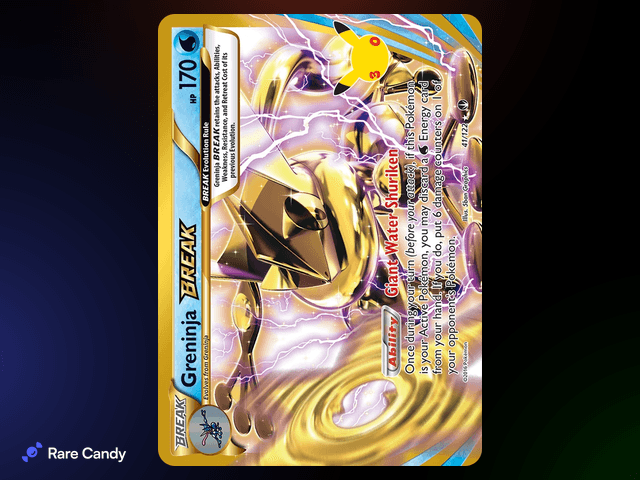
BREAK Evolution arrived in 2016's BREAKthrough, but carried over into BREAKpoint, a sideways evolution that keeps every attack and Ability the prior stage already had while adding a new gold foil treatment and a fresh attack on top. Greninja BREAK, illustrated by 5ban Graphics, is one of the format's most requested BREAK cards, mostly because Greninja was already a fan favorite from X and Y and this was its flashiest print yet. BREAK Evolution never became a permanent mechanic, but it's a clean example of the TCG finding a new way to make an old Pokémon feel new again.
22. Solgaleo GX (89/149), Sun & Moon
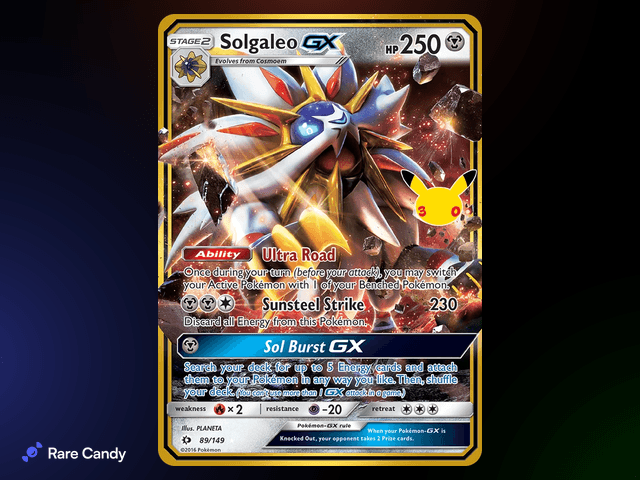
GX replaced EX in 2017's Sun & Moon, the set that started an entirely new TCG generation from scratch around an even bigger attack that could only be used once per game. Solgaleo GX is one of the two version mascots that opened the whole GX era, standing alongside Lunala as the very first Pokémon the format built around. Every GX card that followed for the next two years, all the way through Tag Team GX cards like the Pikachu & Zekrom later on this list, traces back to this exact set.
23. Buzzwole GX (57/111), Crimson Invasion
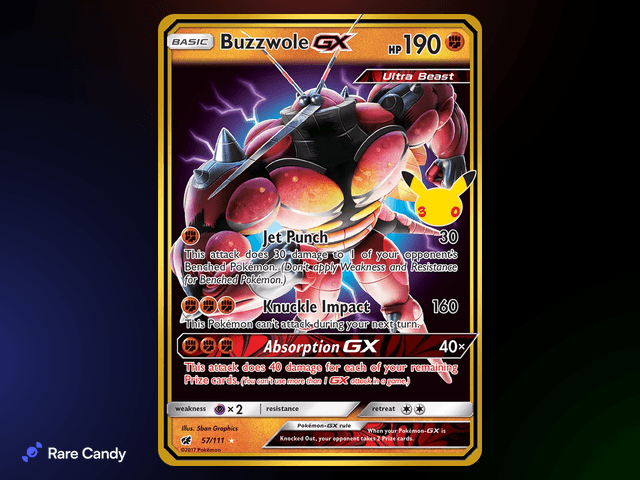
Ultra Beasts showed up in the TCG for the first time in Crimson Invasion, later in 2017, the alien adjacent Pokémon pulled from Ultra Space in Sun and Moon's own story. Buzzwole GX became the most collected Ultra Beast of the entire era almost immediately, thanks to a bench damage attack that made it a genuine threat rather than just a novelty print. It's proof the Ultra Beast concept translated to the TCG a lot better than most one off video game gimmicks usually do.
24. Pikachu & Zekrom GX (33/181), Team Up
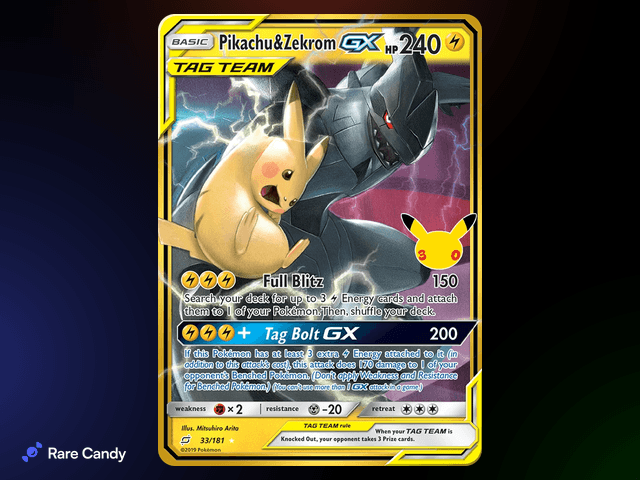
Team Up introduced Tag Team GX cards, two or more Pokémon sharing one card, one HP pool, and attacks that combine both of their names into a single powerful move. Pairing the format's actual mascot with a legendary dragon was always going to be the flagship of that mechanic, and Pikachu & Zekrom GX, illustrated by Mitsuhiro Arita, is exactly that. It's Arita's fourth card on this list, after Pikachu and Charizard from Base Set and Scizor ex from EX Unseen Forces.
25. Zacian V (138/202), Sword & Shield
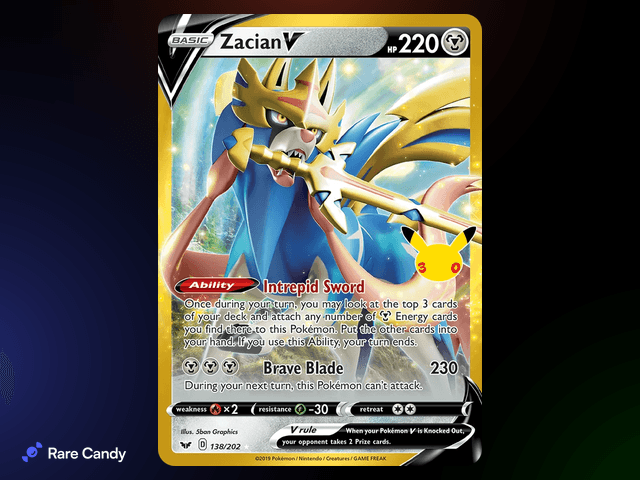
Sword & Shield's 2020 base set retired GX for good and introduced V, a simpler, one tier bigger mechanic that would eventually branch into VMAX and VSTAR over the next two years. Zacian V was one of two legendary wolves chosen to introduce the entire V era, alongside Zamazenta, and it's since become one of the most dominant competitive cards the format has ever produced, not just a chase pull but an actual format defining deck on its own.
26. Raikou (Amazing Rare) (050/185), Vivid Voltage
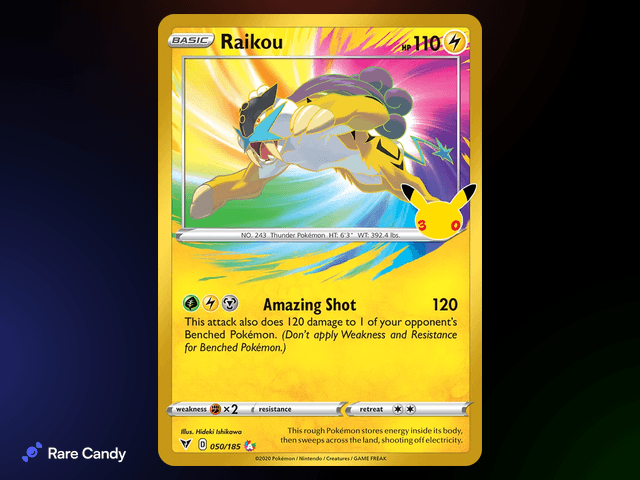
Amazing Rare, a rainbow bordered rarity tier sitting apart from the usual holo and secret rare slots, debuted in Vivid Voltage later in 2020, built to celebrate Dynamax hype from the games without needing a full VMAX card to do it. Raikou, illustrated by Hideki Ishikawa, was one of the earliest Amazing Rares and remains one of the most requested, proof that a new rarity tier can land with collectors even when it's just a fresh coat of paint on a familiar legendary beast.
27. Mew VMAX (114/264), Fusion Strike
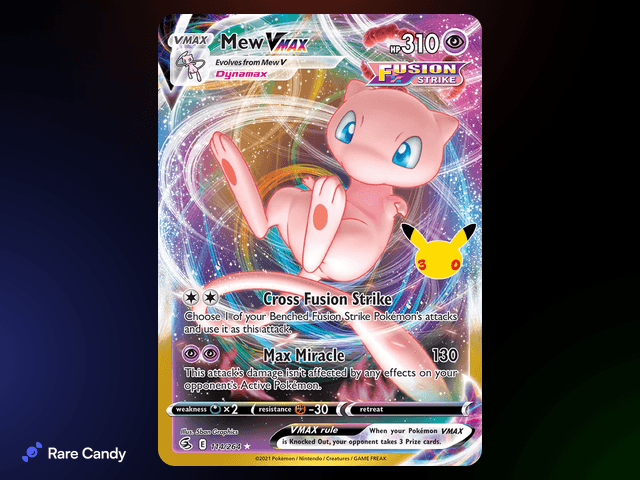
2021's Fusion Strike built its entire 264 card set around Mew, Gengar, and the Fusion Strike Energy type, one of the most sprawling single releases the Sword & Shield series ever produced. Mew VMAX sat at the center of that design, letting any Benched Fusion Strike Pokémon borrow one of its attacks, a genuinely clever piece of deckbuilding glue rather than just a big number on a big card. Fusion Strike's scale, and Mew's role holding all of it together, is exactly why this set still gets brought up as one of the era's best.
28. Arceus VSTAR (123/172), Brilliant Stars
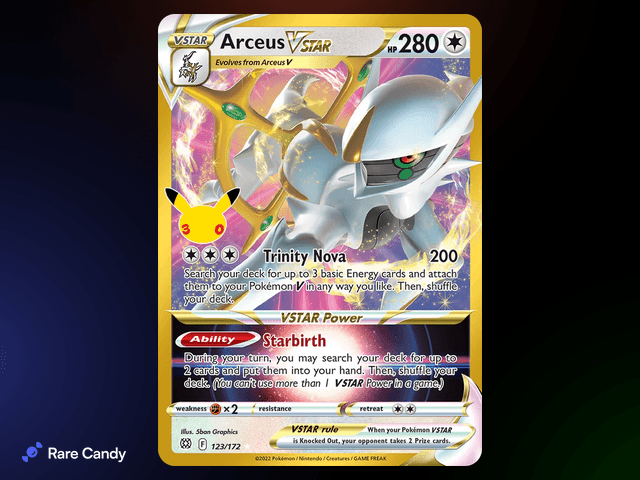
Brilliant Stars is where VSTAR officially entered the game, a one time per match VSTAR Power replacing the old GX attack slot from a few years earlier. Arceus VSTAR is the literal first VSTAR card ever printed, card 123 of a set built specifically to introduce the mechanic. Its Starbirth Ability alone, search two cards into hand every turn, made it one of the most heavily played cards of its entire era, on top of already being a piece of real TCG history the moment it released.
29. Magikarp (203/193), Paldea Evolved
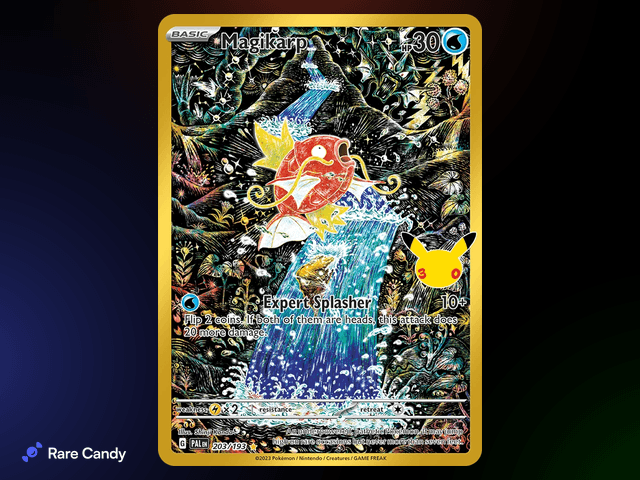
Paldea Evolved was the first true expansion of the Scarlet & Violet era, and it's also home to one of the strangest chase cards the modern TCG has produced. This Magikarp, illustrated by Shinji Kanda, turned the single most joked about Pokémon in the entire franchise into a genuine Illustration Rare grail almost overnight. Closing this list on Magikarp instead of something conventionally impressive feels right. It's the exact kind of card that proves a set's biggest hit doesn't have to be a legendary or fan-favorite to matter.
Final Thoughts
Thirty cards, twenty four years, and every one of them was already a piece of TCG history before this reprint gave it a gold border. What stands out walking through the full list isn't any single pull, it's how deliberately each card was chosen, the actual debut of ex, the actual first VSTAR, the actual cards that turned Misty and Erika into playable characters. 30th Celebration's Classic Collection came by its name honestly. Keep an eye on Rare Candy's Instapacks for 30th Celebration when the set drops on September 16.
FAQ
What is the Classic Collection in 30th Celebration?
A 30 card subset of gold bordered reprints spanning Base Set through Paldea Evolved, each stamped with a "30" Pikachu mark. These are separate from the set's 30 card Pikachu illustration subset and aren't legal for Standard play, they exist purely for collectors.
How many cards are in the Classic Collection?
Thirty reprints total, though Darkrai & Cresselia LEGEND counts as two physical cards that combine into one connected artwork, meaning the checklist runs 29 individually numbered entries covering all 30 cards.
Which Classic Collection card marks the biggest mechanic milestone?
Arceus VSTAR from Brilliant Stars, since it isn't just an example of the VSTAR mechanic, it's the literal first VSTAR card the Pokémon TCG ever printed, back in 2022.
Are Classic Collection reprints tournament legal?
No. Like the rest of 30th Celebration's anniversary only cards, these gold bordered reprints exist purely for collectors and carry no tournament legality in Standard or Expanded play, the same restriction that applies to the set's Pikachu illustration subset.
Where can I get 30th Celebration's Classic Collection cards?
Rare Candy will have 30th Celebration product available at release on September 16, 2026.